Research Note: How can facilitators inspire new AI tools that meaningfully serve collective…
medium.com · by Jigsaw · clipped 2025-11-03
Preview clipped from the web into my Obsidian — read the full piece at the source.

Jigsaw is an incubator within Google that builds technologies to give people greater agency in the world around them.
At Jigsaw, everyone’s a researcher pursuing innovations [in engineering, design, research and beyond] that center human agency. Our Research Notes series offers a look inside our process — sharing early findings, hypotheses and in-flight experiments. We invite you to help shape the future of these ideas, turning our collective curiosity into a force for discovery.
Join us on LinkedIn for a discussion.
TL;DR
This is a first-of-its-kind report co-authored with 13 global experts in facilitating dialogues. The report captures how leading experts believe AI could best support public conversations, including:
- 5 new AI product opportunities derived from needs shared by professional facilitators, complementing their work to deliver outsized impact for dialogues
- An evidence-based framework of three dialogue types to help designers & developers make decisions about how, when, (& whether) to scale conversations using technology
- Ethnographic research with 22 facilitators from 6 continents, grounding the report in lived practical experience from deliberative democracy to peacebuilding to corporate facilitation
- Intended as a roadmap of priorities for the ecosystem on where there are high impact opportunities to invest in AI for large-scale conversations & co-design solutions together with professional facilitators and publics
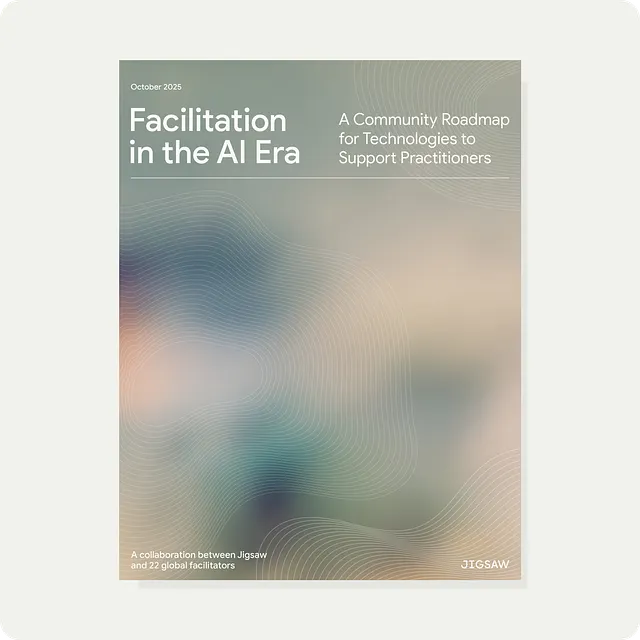
Cover photo of the “Facilitation in the AI Era” report, a collaboration between Jigsaw and 22 global facilitators
Facilitation in the AI era: a new report from Jigsaw
If you speak with people who are experts in leading dialogues and structured conversations, professional facilitators who know how to make public discussions meaningful and effective, they will share with you a counterintuitive truth about the state of civic discourse. “People feel frustrated because they feel benched, not because they’re apathetic,” one leading expert on deliberative democracy told Jigsaw. In other words, members of the public want to have their voices heard and to shape their collective future, but existing institutions aren’t making it easy.
“People feel frustrated because they feel benched, not because they’re apathetic.”
Innovative methods from fields like deliberative democracy and participatory peacebuilding are rising to the occasion, responding to this growing desire for more impactful public discourse by offering people new ways of shaping decisions through dialogue and deliberation. According to one expert, professional facilitators are trying to challenge “the most critical and debilitating syndrome in democratic societies… the inversion that has led us to see the public as a risk we need to manage rather than a resource we should tap.” Novel AI technologies have emerged against this backdrop, offering exciting opportunities and potential challenges for facilitators and the work of empowering the public through conversation. How might AI most effectively support, enhance, or scale the work being done by facilitators to lead better conversations?