On Taste
on-taste.xyz · clipped 2026-07-24
Preview clipped from the web into my Obsidian — read the full piece at the source.
“Why does everything seem so ugly nowadays?” “When did we stop having good taste?” From AI slop to endless movie sequels, sweatpants, and grey concrete buildings, a thought seems to be crystallizing in many circles: our collective aesthetic environment is in decline.
But is there any substance to this claim? For example, is popular music really getting worse? Is “back in my days, we used to have real music on the radio” just boomer nostalgia, or an actual phenomenon?
To explore this, we can turn towards the Billboard Year-End Hot 100, the chart that ranks the best-performing singles of the United States. That’s the “popular” aspect.
I used Rate Your Music (RYM) as a proxy for “artistic value”. RYM is a sprawling, long-running database and community where listeners rate and review albums, singles, and even films and video games. Crucially, the site actively moderates ratings, removes obvious spam, and ensures the averages reflect a serious consensus. For cultural data, it’s about as close to a reliable crowd-sourced record of taste as we have.
So, I took the top 5 most popular songs from the Billboard Hot 100 each year from 1960 to 2024 and looked up their score on Rate Your Music. This gave me an average rating for each year.
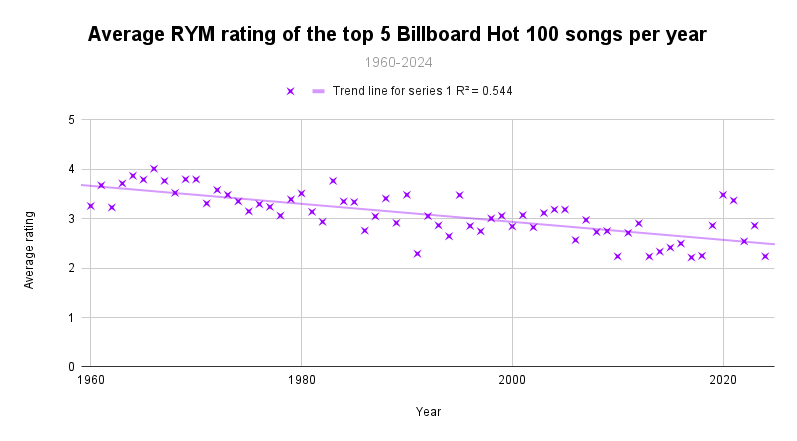
What does this tell us? Ratings for the most popular songs seem to decrease over time. There is some variance, but the correlation is strong (r = 0.74).
Here is a little table comparing 1966, the greatest year on record, with 2017, the worst year:
| Top 5 Billboard Hot 100 songs (1966) | RYM rating | Top 5 Billboard Hot 100 songs (2017) | RYM rating |
|---|---|---|---|
| The Mamas and the Papas - California Dreamin’ | 4.25 | Ed Sheeran - Shape of You | 1.43 |
| ? and The Mysterians - 96 Tears | 3.87 | Luis Fonsi & Daddy Yankee - Despacito | 1.77 |
| Jimmy Ruffin - What Becomes of the Brokenhearted | 3.93 | Bruno Mars - That’s What I Like | 2.93 |
| The Monkees - Last Train to Clarksville | 3.85 | Kendrick Lamar - Humble | 3.36 |
| Four Tops - Reach Out I’ll Be There | 4.14 | The Chainsmokers & Coldplay - Something Just Like This | 1.65 |
Yes, it’s only the top five songs (I didn’t have the resources to go further). And yes, you can nitpick the sample: maybe everyone on RYM is old and hates new music. But the data (and my own experience on the site) suggest otherwise. The majority of users are in the 18–24 range, and they clearly don’t hate pop. Take 2020, for instance: its average score is 3.48 (right up there with the 1970s) and its biggest hits came from The Weeknd, Post Malone, Roddy Ricch, and Dua Lipa.
Ok, maybe you don’t still trust Rate Your Music, that’s fine. There are plenty of other signs.
- In a large-scale analysis of nearly one million songs, Serrà et al. (2012) found that popular music has become increasingly homogenized over time, with transitions between melodies and timbres growing more repetitive and predictable from 1955 to 2010.
- van den Bosch et al. (2024), showed that “song lyrics have become simpler and more repetitive over the last five decades ”.
- A 2020 National Art Survey conducted by The Harris Poll showed that 72% of respondents prefer more traditional, ornamented architectural styles over Modernist styles (consistent across many different dimensions).
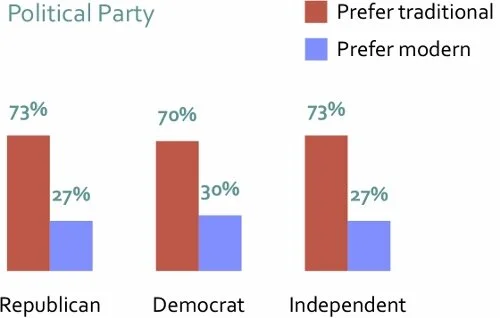
Architecture styles
- In 1995, grey, white, and black represented roughly 40% of the car colors sold in the US. In 2020, they represented more than 70%.
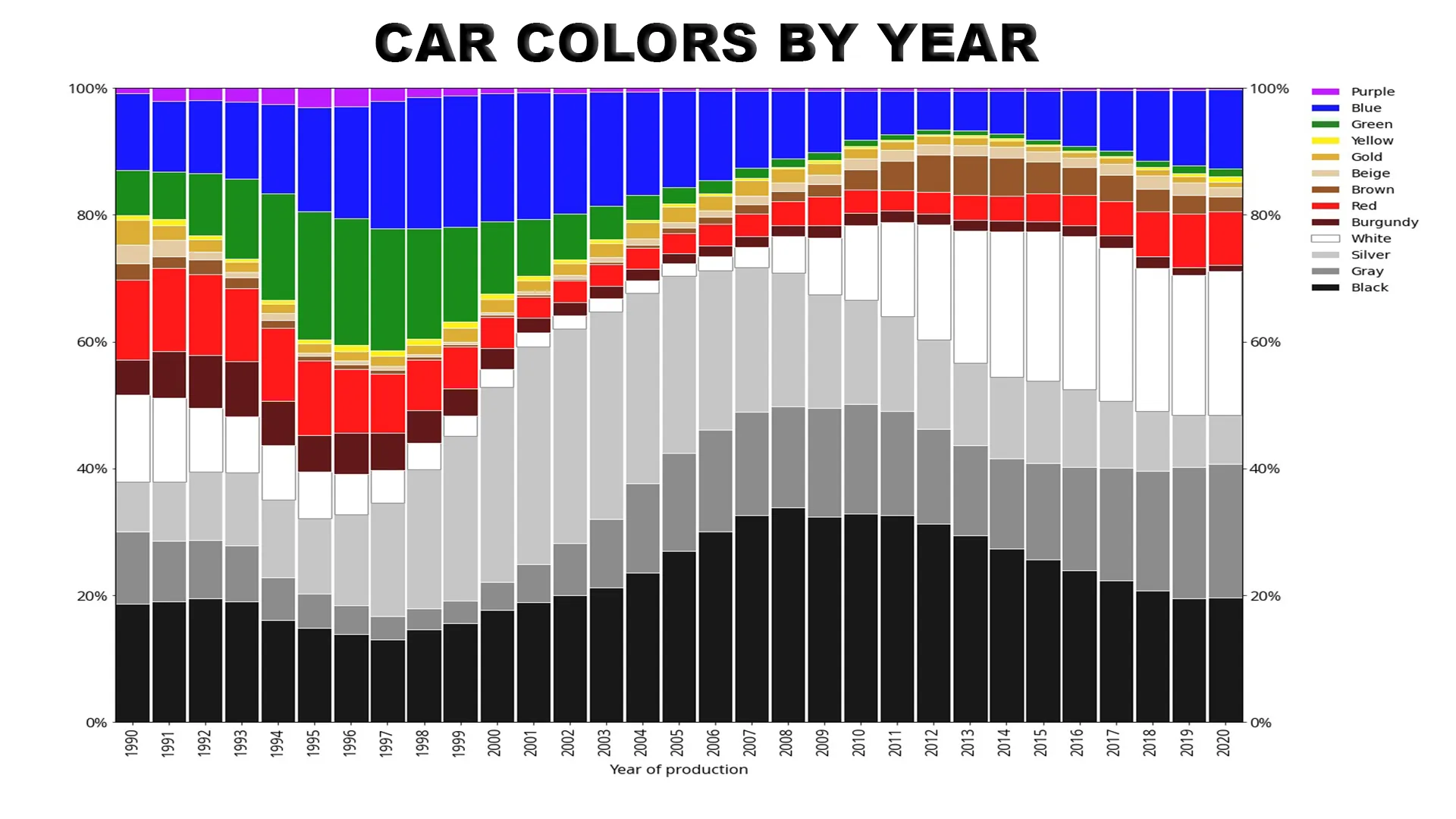
Car color trends
- In the mid 2010s, company logos started all looking like each other, a phenomenon known as blanding.
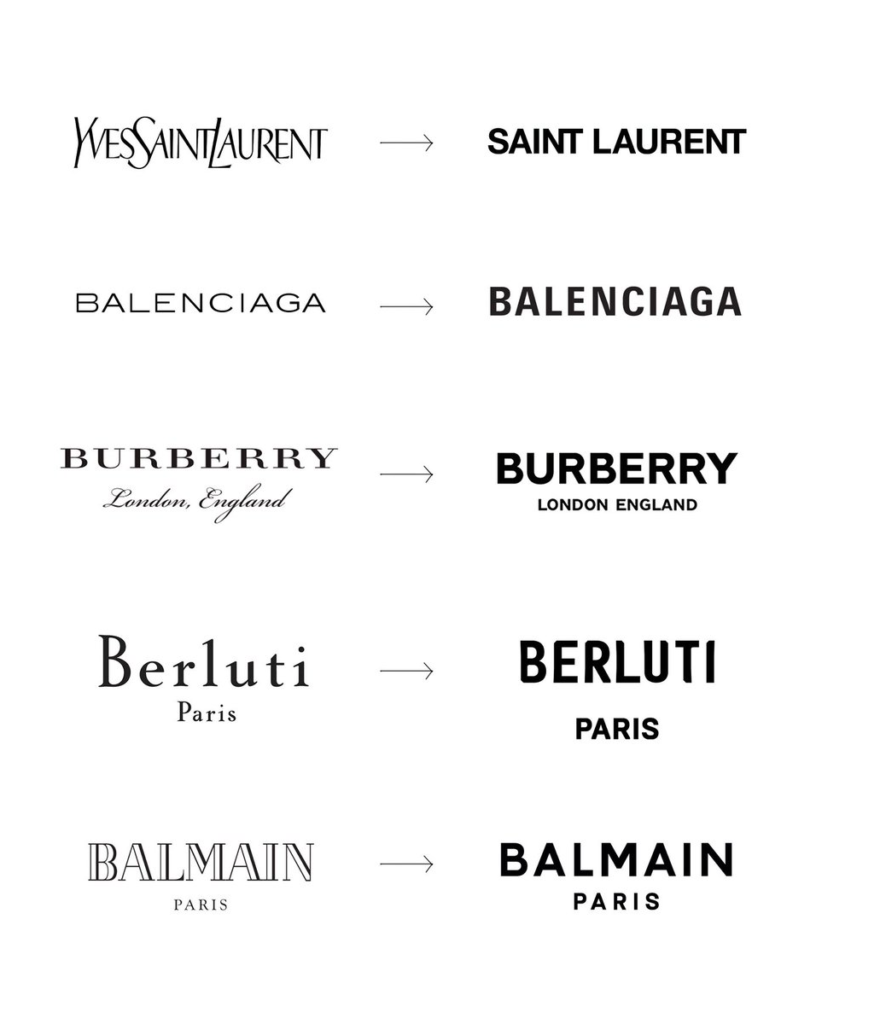
Blanding logos
- Sad beige is now the prevalent aesthetic in many interiors and outfits.

“Sad beige” aesthetic
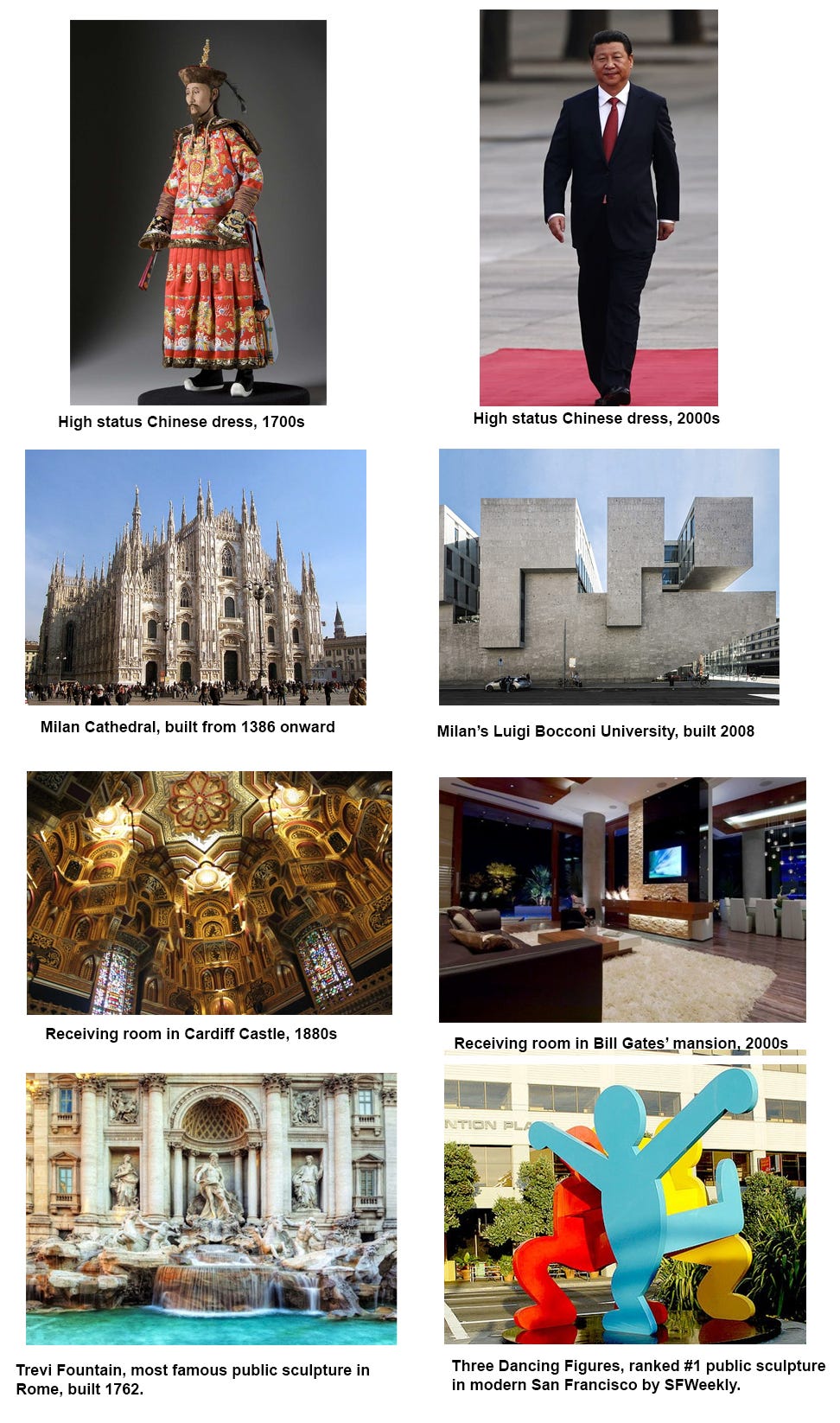
- Everything else. From Scott Alexander:
Scott Alexander collage