@VitalikButerin - Deep funding combines two ideas: 1. Value as a graph

vitalik.eth✓@VitalikButerin
2024-12-14Deep funding combines two ideas:
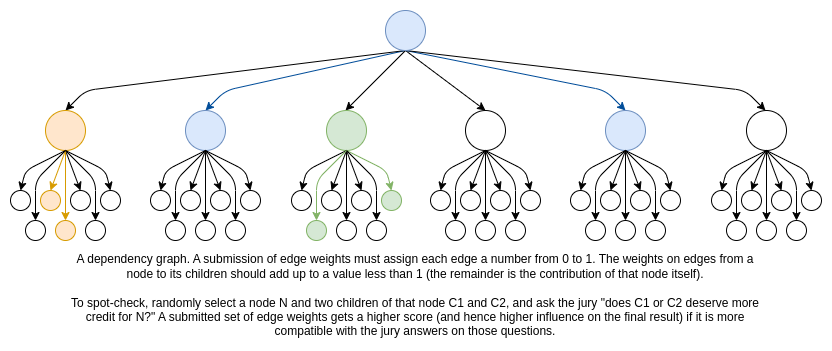
1. Value as a graph: instead of asking "how much did X contribute to humanity?", ask "how much of the credit for Y belongs to X?"
2. Distilled human judgement: an open market of AIs fills in all the weights, human jury randomly spot-checks them
[link to Tweet](https://x.com/TheDevanshMehta/status/1867600164502089925)
(1) has been a growing paradigm recently, for good reason. Contribution is hard to measure in the abstract: if you ask people how much they would pay to save N birds, they answer $80 for N=2000 and N=200000. "Local" questions like "is A or B more valuable to C?" are much more tractable.
(2) is based on ideas in my info finance post: https://vitalik.eth.limo/general/2024/11/09/infofinance.html (From prediction markets to info finance) . Anyone can use any methods (eg. AI) to suggest weights for *all* edges, a human jury does detailed analysis on a random subset. The submissions that are most compatible with the jury answers decide the final output.
https://deepfunding.org/
Devansh Mehta@devanshmehta2024-12-13deep funding is a mechanism that can change ethereum's trajectory its something @VitalikButerin has been working on for a while: how do we effectively distribute revenue earned by an open source software to its different dependencies? a healthy forest doesn't just keep nutrition to the top layer of leaves; it gets spread down to the roots and even to nearby trees in a trading network (see 'hidden lives of trees') deep funding aims to do the same for open source contributions rather than focus on public goods funding (value creation minus value capture), we instead create dependency graphs showing how important one piece of code is relative to another for achieving an outcome repos close to the customer or revenue source then pass along money earned via the root network to all the dependencies that make it what it is so how do we assign weights to dependencies, is the root of the mechanism. there's 3 parts to it; 1. create an unweighted graph showing the package dependencies 2. have a market of AI or metrics based approaches for giving weights to the graph 3. finally, have a jury "spot check" random points of the graph. the model predicting weights closest to jury preferences is chosen to distribute the funds we are completing an end to end implementation of deep funding to the ethereum core repos before eth denver, with $250k of initial funding provided by vitalik thanks so far to @OSObserver for creating the unweighted graph of all dependencies; @Pairwisevote for the spot checking mechanism used by the jury; @dripsnetwork for sending out funds to the repos & sharing the weights data already collected; @evalscience for coaching model builders in the competition; @PollenLabs_ for design in all things of the pilot; and ofc my fellow conspirators @NidhiHarihar & @sejal_rekhan riding into the trenches with me and ensuring the pilot is successful we want more partners, model builders, cofunders & jury members. details to join our TG group in QT below