What’s wrong with grantmaking?
thecounterfactual.substack.com · by Sophie Kim · clipped 2026-07-19
Preview clipped from the web into my Obsidian — read the full piece at the source.
I’m currently working on a BlueDot AI Safety Grantmaking Fundamentals course, and in the process of recruiting grantmakers for curriculum development, I’ve been having chats with several people thinking about field strategy. The following is inspired by a conversation with Evan Miyazono from Atlas Computing (more on Atlas below).

help, i’m money stuck in CG’s vault! let me out!!
In this post, I’ll be attempting to address four questions:
- What’s wrong with passive grantmaking?
- What’s wrong with active grantmaking?
- How do we solve these problems?
- How could we scale this approach?
1. What’s wrong with passive grantmaking?
Passive grantmaking = evaluating proposals.
A grantmaker has to evaluate incoming proposals along two axes:
- Project value: Do I think this project is important? Will it contribute to the goals my organization has set (e.g. reducing existential risk from AI)?
- What are the downside risks? 2. If this project fails, what is the likeliest reason for the failure? 3. In what worlds is this project actively harmful?
- Applicant fit: Is the person who submitted the proposal the right person to do this project?
- How competent are they? Do I think they can execute this proposal well? 2. What do their references look like? How strongly do people they’ve worked with endorse them?
Some notes on the above:
- Finding people who can think critically about what’s needed in the field (henceforth referred to as “field strategists”) is difficult.
- Usually, the people who are best positioned to do this are high-context in AI safety, and have been thinking about what’s missing in the field for a while.
- People with this kind of strategic taste are also likely to already be working in high-level, impactful roles, which means they’re rarely willing to transition away from those roles.
- Usually, the people who are best positioned to do this are high-context in AI safety, and have been thinking about what’s missing in the field for a while.
- Being a good field strategist does not necessarily require execution ability.
Passive grantmaking forces every applicant to have both skills. It doesn’t need to.
2. What’s wrong with active grantmaking?
Active grantmaking is when a grantmaker:
- Comes up with a good idea for a project
- Searches for people in their network to seed the project with
Problems with the above:
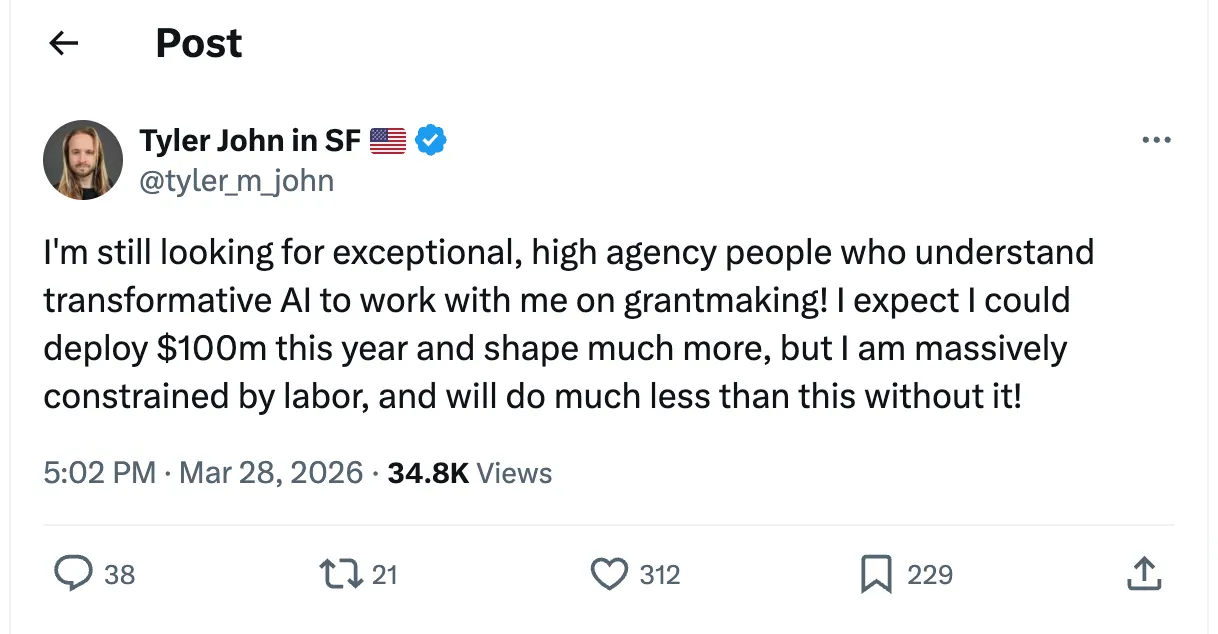
AI safety grantmakers are very very busy
- Grantmaker time is already extremely limited with all of the proposals they receive; grant evaluations at Coefficient Giving, for example, regularly take months to be completed. It’s difficult for an already capacity-constrained grantmaker to set aside time for substantial high-level strategy work.
- Successfully searching for people in your network requires:
- Thinking about who would be a good fit;
- Attempting to pitch people to potentially leave their jobs to do this other thing;
- Having sufficiently high confidence in the people you pitch.
- An unfortunate failure mode of active grantmaking: pitching someone on a project, getting them to put in the effort to apply for funding, realizing they aren’t a good fit while evaluating their application, and having to say no.
- Thinking about who would be a good fit;
The above assumes that you happen to know people who would be a good fit for your project at all.
3. How do we solve these problems?
The key to optimizing grantmaking is specialization: separating project proposals from people– separating evaluations of project value from applicant fit.
Two case studies:
1. The Institute For Progress (IFP)
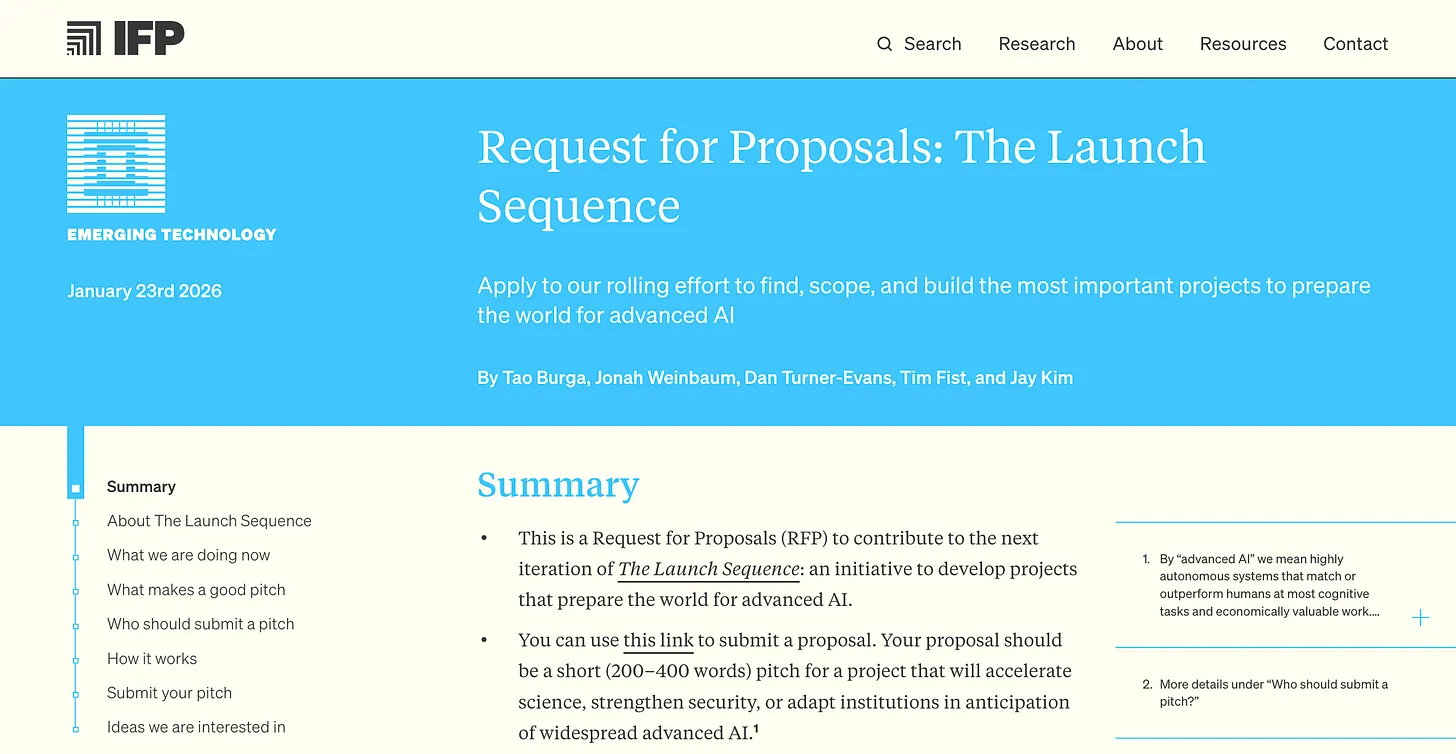
IFP’s Launch Sequence is an open call for project proposals “that prepare the world for advanced AI.” They write:
“You should submit a proposal if you have a good idea, even if you don’t expect to be the person actually leading or working on the resulting project … If your proposal is selected, we’ll work closely with you to develop the idea into a concrete project plan, publish your plan, connect you with philanthropic funders, and help you headhunt for a project lead or co-lead.”